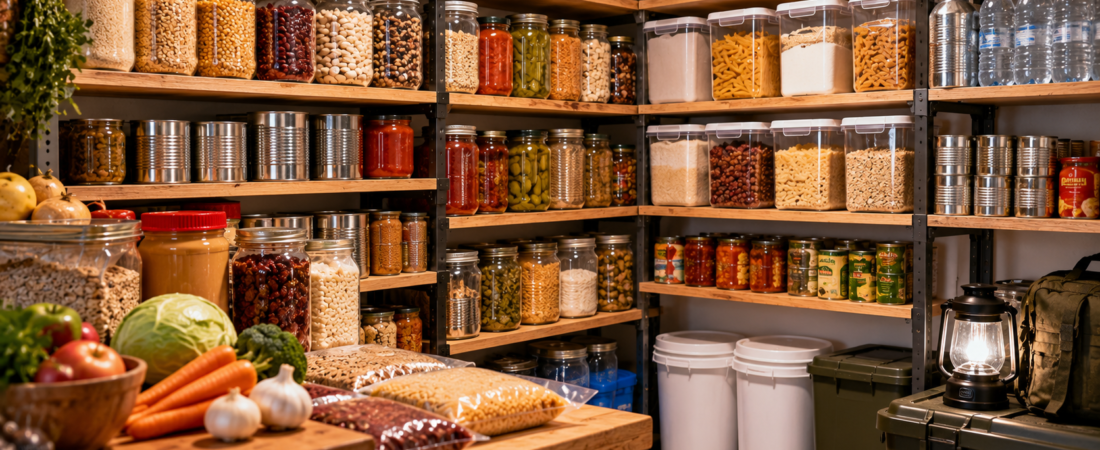
What’s in your pantry? It’s been several days since your normal grocery routine stopped. The supermarket is open, but the shelves are unpredictable. You don’t know when your next normal shopping trip will happen.
Affiliate Disclosure: This post may contain affiliate links. I may earn a commission at no extra cost to you.
You open the pantry.
Cans, boxes, bags, jars, and packages everywhere.
At first, it looks like you have plenty of food.
Then you start asking questions.
How much of this can actually become a meal?
What will we run out of first?
What requires cooking?
What needs refrigeration after opening?
And perhaps the biggest question:
Did I actually store the right things?
That’s the part of emergency food preparation that people often overlook.
Building a long-term pantry isn’t simply about accumulating as many shelf-stable foods as possible. It’s about creating a supply that can keep going when your normal grocery routine isn’t available.
So what should actually be in it?
Let’s work through the pantry one category at a time.
Start With Foods That Can Carry a Meal
When you’re several days into a disruption, you aren’t just looking for another snack. You need foods that can form the foundation of a meal.
This is where staple foods become important.
Your pantry might contain white rice, spaghetti, elbow macaroni, rolled oats, cornmeal, or other familiar grain-based foods.
You don’t necessarily need every type.
Instead, think about what your household already eats.
If rice appears on your dinner table regularly, keeping an additional supply makes sense. If your family rarely eats pasta, buying a huge quantity simply because it’s commonly recommended may not be useful.
The same principle applies throughout the pantry:
Store foods you can realistically see yourself eating.
Your emergency pantry doesn’t need to become a completely different kitchen.
It should extend the kitchen you already have.
A practical example
Suppose your household normally eats spaghetti once a week.
Maintaining a supply of spaghetti, pasta sauce, canned tomatoes, and the seasonings you normally use gives you ingredients you already know how to turn into a meal.
That’s more useful than buying an unfamiliar product simply because it appears on an emergency-preparedness list.
Then Ask: Where Is the Protein?
A pantry can look well stocked while being surprisingly light on protein.
Beans can help fill that gap.
Depending on your household’s preferences and dietary needs, your shelves might include black beans, pinto beans, kidney beans, chickpeas, peanut butter, canned fish, canned meat, or other shelf-stable protein sources.
Dried beans can provide an economical option when you have the time, water, and cooking method needed to prepare them.
Canned beans offer another advantage: convenience.
The important thing isn’t finding one magical emergency food.
It’s having practical options that fit the way your household eats.
Preparation time matters here, too. A pantry containing only foods that require lengthy cooking may become inconvenient if your normal cooking situation changes.
A practical example
Two cans of black beans alongside rice and canned corn can give you the starting point for a simple meal.
Compare that with having ten bags of rice and almost nothing else to accompany them.
The second pantry may contain more of one particular food, but the first gives you more immediate flexibility.
Don’t Forget Fruits and Vegetables

A pantry built around rice, pasta, beans, and other staples can quickly become repetitive.
Shelf-stable fruits and vegetables provide another layer of variety.
Examples include canned green beans, corn, peas, carrots, mixed vegetables, peaches, pears, pineapple, and applesauce.
You don’t have to stock every variety available.
Think about the foods your household already uses.
If canned corn disappears quickly during normal grocery shopping, keeping additional cans available may make sense. If nobody touches canned peaches, there’s little reason to fill your shelves with them.
The goal isn’t to create the most impressive pantry.
It’s to create one your household will actually use.
Adding a can of vegetables to a basic meal can make the food feel more complete without requiring an entirely different recipe. Shelf-stable fruit can provide a welcome change from savory foods.
Small additions like these can matter when you’re eating from the same supply for an extended period.
What About Cooking Ingredients?
One of the easiest gaps to overlook is the collection of ingredients that make basic foods taste like actual meals.
You might have pasta, canned tomatoes, beans, and vegetables but discover that you’re short on cooking oil, broth, sauces, or the seasonings your household normally uses.
These items may not seem as important as a large bag of rice or a case of canned food, but they can make your main ingredients much more useful.
A practical pantry might include cooking oil, salt, black pepper, garlic powder, chili powder, Italian seasoning, bouillon or broth, and sauces your household regularly uses.
You don’t need an enormous collection.
Focus on the ingredients that already have a place in your cooking routine.
A simple combination
Consider pasta, canned tomatoes, Italian seasoning, garlic powder, and cooking oil.
None of these items is particularly unusual. Together, however, they provide much more flexibility than a box of pasta sitting by itself.
This is why it’s useful to think beyond the major food categories.
Sometimes the small supporting ingredients make the difference between “I have food” and “I know what I can make.”
Include Some Foods That Don’t Require Much Work
Not every day will be a good day for cooking.
You may be tired, dealing with a disruption, or simply unable to use your normal kitchen setup.
That’s where ready-to-eat and low-preparation foods become useful.
Examples might include canned beans, canned fruit, crackers, peanut butter, applesauce, shelf-stable protein foods, and other suitable foods that require little preparation.
This doesn’t mean your pantry should consist entirely of convenience foods.
They simply provide another option.
A long-term pantry shouldn’t depend entirely on one preparation method.
Some foods can form cooked meals, while others can provide something to eat when cooking isn’t practical.
Store Foods Your Household Will Actually Rotate

A pantry can be beautifully organized and still fail if the food simply sits there untouched.
Rotation solves part of that problem.
If you store rice, eat rice. If you store canned vegetables, use them. If you buy pasta, include it in your normal meals. Then replace what you use.
For example, if your household normally goes through three cans of vegetables each week, buying a few additional cans and using the oldest ones first is easier to manage than purchasing a huge quantity and forgetting about it.
The same principle applies to pasta, rice, canned beans, sauces, and other foods you routinely consume.
Regular use also teaches you something important: which foods your household actually likes.
A product can look perfect on a preparedness list and still be a poor choice for your pantry if nobody wants to eat it.
Your normal grocery habits are therefore useful information.
Pay attention to what disappears quickly and what remains untouched.
Think About Preparation, Not Just Quantity
A large food supply still depends on the resources required to use it.
Dry staples such as rice, dried beans, and pasta generally require some combination of water, heat, cooking time, and fuel.
That doesn’t make them bad choices.
It means you need to consider the complete picture.
When planning your pantry, ask:
What food do we have?
How do we prepare it?
What does preparation require?
What can we eat with little preparation?
Those questions can reveal gaps that a simple food-counting exercise won’t.
For example, suppose a pantry contains a large quantity of rice and dried beans but very few foods requiring minimal preparation. That supply may work well under normal cooking conditions but provide fewer options if those conditions change.
Adding some low-preparation foods doesn’t mean abandoning the staples.
It simply makes the overall supply more flexible.
Water deserves particular attention. Food preparation can require additional water beyond drinking needs, so consider both when planning.
Don’t Build the Pantry Around One Emergency Scenario
“Long-term emergency” can mean many different things.
A prolonged interruption to normal shopping isn’t necessarily the same as a power outage, water interruption, severe storm, or another type of disruption.
Rather than designing the entire pantry around one specific event, aim for flexibility.
Some foods can be cooked normally. Others require little preparation. Some work primarily as ingredients, while others can be eaten on their own.
That range of uses can make the pantry more adaptable.
Compare two pantry approaches
Pantry A: Large quantities of rice and dried beans.
Pantry B: Rice, pasta, canned beans, canned vegetables, canned fruit, peanut butter, crackers, sauces, cooking ingredients, and a few low-preparation foods.
Neither arrangement is automatically appropriate for every household or every situation.
But the second approach illustrates the value of having different types of food available rather than relying heavily on two staples.
A Practical Long-Term Pantry Framework
Rather than trying to memorize a giant shopping list, think in categories.
1. Staple Foods
Examples include white rice, pasta, oats, cornmeal, and other grains or starches your household regularly eats.
2. Protein
Examples could include dried beans, canned beans, peanut butter, canned fish, canned meat, or other shelf-stable protein sources appropriate for your household.
3. Vegetables
Consider corn, green beans, peas, carrots, mixed vegetables, tomatoes, and other canned or shelf-stable vegetables that your household will actually use.
4. Fruit
Examples include peaches, pears, pineapple, applesauce, or other shelf-stable fruit products.
5. Cooking Ingredients
This category could include cooking oil, salt, pepper, seasoning blends, broth, bouillon, tomato sauce, and other ingredients you routinely use.
6. Ready-to-Eat Options
Examples might include canned beans, canned fruit, crackers, peanut butter, shelf-stable protein foods, and other foods requiring little preparation.
7. Familiar Snacks
A few suitable shelf-stable snacks can provide variety and make an extended period of eating from the pantry more manageable.
The exact quantities depend on your household size, dietary requirements, storage space, budget, and the length and type of disruption you’re preparing for.
There isn’t one universal pantry number that works for everyone.
What Should You Buy First?
If you’re starting from scratch, don’t try to fill every category in one shopping trip.
Start with the foods your household already eats regularly.
Then look for obvious gaps.
Maybe you have plenty of pasta and rice but very little protein. Maybe you have canned vegetables but almost no fruit. Perhaps you have plenty of food but very few ingredients to prepare it. Or maybe most of your pantry requires extensive cooking.
Those observations are more useful than simply counting packages.
For example
Suppose your current pantry already contains pasta, rice, canned vegetables, and oatmeal.
Instead of buying more of those same foods, your next purchases might address the gaps: perhaps beans, cooking oil, canned fruit, broth, seasonings, and a few low-preparation foods.
That doesn’t mean those items are universally more important.
They simply make sense because of what is already in this particular pantry.
That’s the mindset to use.
The Pantry Test
Here’s a simple exercise you can do today.
Open your pantry and choose ten items.
For each one, ask:
Would my household actually eat this?
Can I use it in a meal or as part of one?
How much preparation does it require?
What other ingredients does it depend on?
Would I buy it again?
If you struggle to answer those questions for several of your stored foods, you’ve probably found an opportunity to improve your pantry.
You don’t need to throw everything away or start over.
Simply let your future purchases reflect what you’ve learned.
Recommended Resource: The Lost Super Foods
If you’re building a long-term emergency food supply, it’s worth learning about the foods our grandparents and earlier generations relied on before modern refrigeration and grocery stores became common.
The Lost Super Foods is a guide that explores forgotten preservation methods, shelf-stable foods, and traditional survival recipes that helped families thrive during difficult times. The guide includes practical information on food storage, preservation techniques, and nutrient-dense foods that can complement a well-stocked emergency pantry.
Whether you’re just starting your preparedness journey or looking to expand your food storage knowledge, this resource may provide valuable insights for creating a more resilient pantry.
👉 Click here to learn more about The Lost Super Foods.
Final Thoughts
Go back to that opening situation.
The grocery store isn’t part of your normal routine anymore.
You open the pantry and start figuring out dinner.
This time, instead of finding a random collection of shelf-stable foods, you find ingredients you recognize and know how to use.
There’s rice or pasta for the foundation.
There’s beans or another suitable protein source.
There’s a can of vegetables and perhaps some fruit for variety.
The cooking ingredients are available.
And if you don’t want to spend an hour preparing everything, you have a few simpler options as well.
That’s what a useful long-term emergency pantry should accomplish.
Not perfection.
Not the biggest stockpile.
Not a shelf full of foods you’ve never eaten.
It should give you practical choices when your normal food routine isn’t available.
Start with the foods your household already knows and enjoys. Add variety where you’re missing it. Consider water and cooking requirements. Keep some low-preparation options available. Rotate what you store instead of letting it disappear into the back of the pantry.
Then build from there.
Because when you eventually open that pantry during a difficult week, the most important question won’t be:
“How much food did I store?”
It will be:
“What can I actually make with what I have?”
Related Articles
Check out the articles below to increase your emergency food knowledge:
30 No Cook Foods For An Emergency