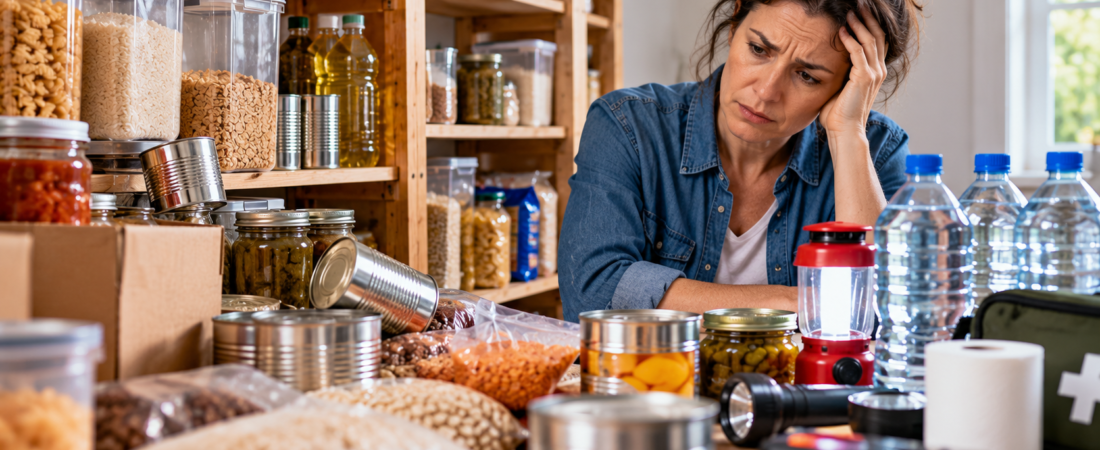
Building an emergency pantry sounds simple: buy extra food and put it on the shelf.
In practice, it’s easy to make decisions that leave you with plenty of food but a pantry that isn’t particularly useful. You may buy foods nobody eats, overlook things you actually need, run short of cooking essentials, or lose track of what’s sitting in the back of the cabinet.
The good news is that most pantry problems are easy to correct.
You don’t need to start over. You need to identify where your current approach isn’t working and make a few practical changes.
Here are seven common mistakes—and the straightforward fixes.
Affiliate Disclosure: This post may contain affiliate links. I may earn a commission at no extra cost to you.
FREE Checklist: 10 Forgotten Survival Foods That Can Last For Years
By clicking below, you’re opting in to receive your free checklist and occasional helpful tips about emergency food storage.
Get Your FREE Survival Foods Checklist Here!
1. Buying Food You Don’t Normally Eat

The mistake: Building your pantry around someone else’s emergency-food list.
You see recommendations for dried beans, powdered milk, wheat, canned fish, or another supposedly essential food and decide you need several containers of it.
Then you discover that nobody in your household actually wants to eat it.
Unfamiliar food may sit untouched, and you may not know how to prepare it. If it never becomes part of your normal meals, there’s also little reason to rotate it through your pantry.
The fix: Start with the foods your household already buys and enjoys.
Look at your normal grocery habits and identify the staples that regularly make their way into your meals. Those familiar foods are usually a better starting point than someone else’s ideal list.
If you want to try something new, buy a small amount first. Use it in an ordinary meal, decide whether your household likes it, and only then consider buying more.
Don’t stock a food simply because someone says you should. Stock it because you have a realistic use for it.
2. Buying Too Much of One Food
The mistake: Assuming that a large quantity automatically means better preparation.
An inexpensive and versatile food can be tempting to buy in bulk. The problem appears later when you realize that a large portion of your pantry consists of one ingredient while other categories are nearly empty.
Having plenty of rice but very little protein is one example. Having a large supply of canned vegetables but few cooking ingredients is another.
The problem isn’t necessarily the quantity.
It’s the imbalance.
The fix: Look at the pantry as a whole before making another large purchase.
Instead of asking, “How much more of this should I buy?” ask, “What am I missing?”
You may need another staple, a different type of protein, more ready-to-eat food, or ingredients that make your existing supplies easier to prepare.
You don’t need equal amounts of everything. You simply want enough variety that one missing category doesn’t make the rest of your pantry much harder to use.
3. Forgetting About Water and Cooking Requirements
The mistake: Counting food without considering what is required to prepare it.
A shelf full of rice, pasta, and dried beans can look impressive until you consider the water, heat, cooking time, and fuel required to turn those ingredients into meals.
This becomes particularly important if you’re preparing for a disruption that could affect electricity, gas, water service, or your normal cooking setup.
The foods themselves aren’t necessarily the problem.
The problem is ignoring the conditions under which you’ll need to use them.
The fix: Look at your pantry from the preparation side.
For the foods you rely on most, consider how much water they need, how long they take to prepare, and what cooking method they require.
You don’t have to remove foods that require cooking. Instead, avoid making your entire supply dependent on them.
Include some foods that require little preparation, and consider food-preparation water separately from drinking-water needs.
The goal is simple: make sure your food supply matches the situation you’re preparing for.
4. Ignoring the Ingredients That Make Your Staples Useful
The mistake: Stocking the main ingredients while overlooking the supporting ones.
It’s easy to concentrate on rice, pasta, beans, canned vegetables, and other obvious staples.
Then you discover you don’t have the oil, sauces, broth, seasonings, or other ingredients your household normally uses.
A pantry can contain plenty of food and still be frustrating to cook from.
The fix: Think about what you normally use when preparing your everyday meals.
If your household regularly eats pasta, what normally goes with it? If you cook rice or beans, what ingredients make those meals familiar?
You don’t need to stock every condiment in the grocery store.
Focus on the few cooking ingredients your household actually relies on, and make sure they’re represented in your pantry along with the foods they’re meant to accompany.
5. Treating the Pantry Like a Storage Closet

The mistake: Putting food wherever there happens to be room.
This usually works for a while.
Then newer purchases get placed in front of older ones, different categories become mixed together, and you lose track of what you own.
Eventually, you may buy something you already have because you can’t find it, while another item remains forgotten at the back of a shelf.
The fix: Give your pantry a simple system.
Group similar foods together and keep those categories in roughly the same locations. You don’t need elaborate containers, decorative labels, or a professionally organized pantry.
The important thing is being able to find things quickly and know what you already have.
When practical, place older items where they’ll be used before newer purchases. A basic first-in, first-out approach can keep the supply moving without making pantry management complicated.
6. Building the Pantry Without a Budget
The mistake: Treating emergency preparation as an excuse to buy everything that looks useful.
A sale catches your attention. A news story raises concerns about shortages. Another preparedness article gives you a new list of “essential” foods.
Before long, you’ve spent considerably more than planned—and may still have important gaps.
The problem isn’t preparing.
It’s preparing without a spending strategy.
The fix: Set a pantry budget that fits your normal finances.
You might add a small amount to each grocery trip or set aside money periodically for pantry purchases. The amount isn’t nearly as important as having a limit you can maintain.
Also separate genuine needs from tempting bargains.
A discounted food you won’t use isn’t necessarily a good purchase. A smaller supply of foods your household regularly eats may provide much more value.
If your budget is limited, build gradually rather than trying to create a large stockpile in one shopping trip.
7. Forgetting to Check What You Already Have
The mistake: Building the pantry and then leaving it untouched.
Months go by. You continue grocery shopping without checking your existing supply.
Eventually, you discover duplicate purchases, forgotten items, damaged packages, or foods your household no longer wants.
A pantry isn’t a one-time project.
The fix: Give it a quick review every few months.
Look at what you’re actually using and what has been sitting untouched. Check for obvious gaps, replace foods you regularly consume, and deal with damaged or questionable packaging.
This doesn’t need to become an elaborate inventory exercise.
A short review is enough to keep you aware of what’s available.
The goal is simply to make sure your pantry reflects your household as it exists now, rather than the household you imagined when you first started stocking it.
Practical Emergency Pantry Checklist
Once you’ve worked through the seven mistakes, use this checklist to identify what needs attention.
You don’t have to complete everything at once. Start with the areas that expose the biggest weakness.
Food
☐ Most of the foods we store are foods our household actually eats.
☐ We’ve tested unfamiliar foods before buying them in large quantities.
☐ Our supply has reasonable variety rather than being dominated by one item.
☐ We have foods requiring different levels of preparation.
☐ We have some options that can be prepared relatively quickly.
Pantry Staples
☐ We have staple foods our household regularly uses.
☐ We have suitable protein sources.
☐ We have canned or shelf-stable vegetables.
☐ We have canned or shelf-stable fruits.
☐ We have cooking oil or another appropriate cooking fat.
☐ We have the seasonings we normally use.
☐ We have sauces, broth, or other familiar cooking ingredients.
☐ We have a few snacks or comfort foods.
Water & Preparation
☐ We’ve considered the water requirements of our stored foods.
☐ We know which foods require cooking.
☐ We’ve considered what cooking method would be available during a disruption.
☐ We have some foods requiring little preparation.
☐ We’ve considered drinking water separately from food-preparation water.
Organization
☐ Similar foods are grouped together.
☐ We can quickly locate major pantry categories.
☐ Older items are positioned to be used before newer purchases when practical.
☐ We can see what we already have before shopping.
☐ Packages and containers are easy to identify.
☐ We have enough space for the food we’re actually buying.
Budget
☐ We have a realistic pantry budget.
☐ We prioritize foods our household actually uses.
☐ We don’t routinely buy food simply because it’s on sale.
☐ We add to the pantry gradually when necessary.
☐ We know which areas need attention before making another large purchase.
Maintenance
☐ We periodically review the pantry.
☐ We deal with damaged packages or containers.
☐ We notice foods that have been sitting unused.
☐ We replace foods we regularly consume.
☐ We adjust our supply when our household’s needs change.
What Should You Fix First?
If several items on the checklist need attention, don’t try to correct everything at once.
Start with the biggest weakness.
If your pantry contains foods nobody eats, change what you’re buying. If you’re heavily stocked in one category, add variety. If preparation is the problem, add some lower-preparation options. If organization is causing duplicate purchases, rearrange the shelves.
If spending has become the problem, set your budget before your next shopping trip.
The point of the checklist isn’t to create another complicated preparedness project.
It’s to turn “I should probably improve my pantry” into a few specific actions you can actually take.
Recommended Resource: The Lost Super Foods
If you’re building a long-term emergency food supply, it’s worth learning about the foods our grandparents and earlier generations relied on before modern refrigeration and grocery stores became common.
The Lost Super Foods is a guide that explores forgotten preservation methods, shelf-stable foods, and traditional survival recipes that helped families thrive during difficult times. The guide includes practical information on food storage, preservation techniques, and nutrient-dense foods that can complement a well-stocked emergency pantry.
Whether you’re just starting your preparedness journey or looking to expand your food storage knowledge, this resource may provide valuable insights for creating a more resilient pantry.
👉 Click here to learn more about The Lost Super Foods.
Final Thoughts
A useful emergency pantry isn’t measured by how many cans, bags, or boxes you can fit onto a shelf.
It’s measured by whether the food actually works for your household.
Stock foods people will eat. Keep the supply reasonably varied. Consider how you’ll prepare what you’ve stored, not just where you’ll put it. Pay attention to the supporting ingredients, keep the shelves organized, stay within a realistic budget, and review the pantry periodically.
Most importantly, don’t try to build everything at once.
Start with what you already have, correct the biggest weakness first, and build from there.
Related Articles
10 Pantry Foods That Are Easier To Store Than You Think