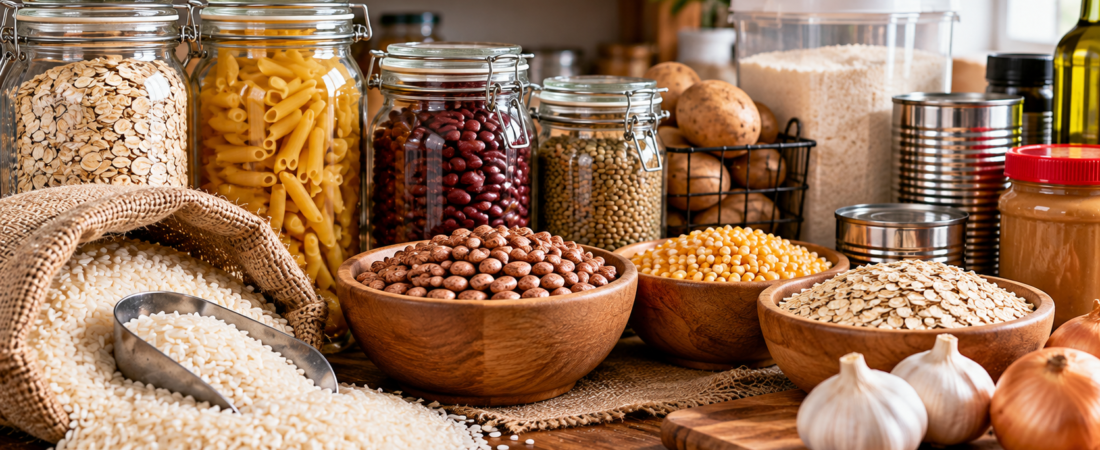
Building an emergency pantry with pantry foods can sound like a much bigger project than it really is.
Affiliate Disclosure: This post may contain affiliate links. I may earn a commission at no extra cost to you.
You may picture shelves filled with specialized containers, carefully measured portions, expensive storage systems, and foods purchased specifically for long-term emergencies.
But here’s the good news: you probably already have more pantry-friendly foods than you realize.
The problem isn’t always finding food to store. Often, it’s knowing which everyday foods are worth keeping on hand and how to build a pantry that fits your household instead of someone else’s checklist.
You don’t need to turn your kitchen into a warehouse overnight.
A useful pantry can be built gradually around foods you already recognize, prepare, and enjoy.
Below are 10 foods that are often easier to incorporate into a practical pantry than people expect.
A Quick Word About Storage
Most shelf-stable pantry foods should be stored according to the manufacturer’s recommendations in a suitable pantry environment away from excessive heat, moisture, and pests.
That’s the basic rule.
Beyond that, individual pantry foods have different characteristics, package types, and storage considerations. Ordinary pantry storage is also different from specialized long-term food preservation, so don’t assume that every shelf-stable product has the same storage life.
For everyday emergency preparation, the goal can be much simpler:
Have useful food available, know what you have, and actually use it.
FREE Checklist: 10 Survival Foods That Can Last For Years
By clicking below, you’re opting in to receive your free checklist and joining my mailing list.
Get Your Free Survival Foods Checklist Here!
With that in mind, here are 10 foods worth a closer look.
Rice is one of those foods that can seem almost too ordinary to be considered an emergency-pantry staple.
That’s actually one of its advantages.
1. White Rice

White rice is familiar, affordable, and adaptable. It can serve as a side dish or become the foundation of a simple meal, making it useful across many different situations.
It also doesn’t require you to learn a new cooking method. If rice is already part of your normal meals, keeping an additional supply is relatively straightforward.
The mistake is assuming that more is automatically better.
Before buying a large quantity, consider how often your household actually eats rice and how much space you have available. A huge bag that sits untouched isn’t necessarily more useful than a modest supply that gets used regularly.
Rice also pairs naturally with many common pantry ingredients, so you don’t have to build an entirely separate menu around it.
If you already keep beans, vegetables, sauces, or seasonings on hand, rice can fit comfortably into meals you know how to prepare.
That’s what makes an ordinary staple like rice valuable: you already know what to do with it.
2. Dried Beans
Dried beans sometimes get overlooked because they require more preparation than many canned foods.
That isn’t necessarily a disadvantage.
If you regularly cook chili, soups, bean dishes, or similar meals, dried beans can be an economical way to add variety to your pantry.
Black beans, pinto beans, kidney beans, navy beans, and other varieties each have slightly different uses, flavors, and textures.
The more important question is whether your household has the time and ability to cook them.
That’s particularly worth considering when preparing for a disruption. Dried beans require water, cooking time, and an appropriate heat source.
If those resources are available, they’re a useful pantry staple.
If you’re preparing for a situation where cooking could be difficult, you’ll want other foods that require less preparation as well.
This is why a balanced pantry usually makes more sense than relying heavily on one type of food.
Dried beans can fill one role.
They don’t have to fill every role.
3. Pasta
Pasta is another food that may look unremarkable sitting on a pantry shelf.
But its familiarity is precisely what makes it practical.
Most households already know how to prepare it, and there are countless ways to vary the finished dish.
Spaghetti, macaroni, penne, rotini, and other shapes can all be useful depending on what your household normally cooks.
You also don’t have to stock every variety.
Choose the shapes your household actually enjoys.
That’s an easy way to avoid one of the biggest pantry problems: accumulating food simply because someone says it belongs in an emergency supply.
If nobody likes a particular type of pasta, it doesn’t matter how inexpensive or shelf-stable it is.
Your pantry should reflect your household.
Pasta also works well with many other common ingredients, which gives you flexibility without requiring specialized emergency recipes.
4. Rolled Oats
Oats are often treated as nothing more than breakfast food.
But their usefulness can extend beyond a morning bowl of oatmeal.
They can be used in baked foods, snack mixtures, and other recipes, depending on what you normally make.
More importantly, oats illustrate a principle that’s easy to overlook:
Ordinary food can be perfectly good emergency food.
You don’t necessarily need special products with “emergency” printed on the package.
If your family already eats oatmeal, keeping additional oats available is relatively easy because you’re naturally going to use them.
That creates a built-in rotation system.
You don’t have to remember to consume a food that nobody likes.
You simply continue eating something that’s already part of your routine.
The same principle can apply to many other everyday pantry staples.
Instead of asking which foods are most popular on emergency-preparedness lists, start by asking which foods your own household already buys repeatedly.
5. Canned Tomatoes
Canned tomatoes aren’t necessarily exciting on their own, but they’re incredibly useful for adding depth and variety to simple meals.
Diced tomatoes can go into soups, stews, rice dishes, and pasta.
Crushed tomatoes can form the base of sauces.
Tomato paste can add concentrated flavor to dishes that might otherwise taste flat.
This makes canned tomatoes a good example of a supporting pantry ingredient.
You may not sit down and eat a can of tomatoes as your dinner.
But a relatively small amount can change the character of an otherwise basic dish.
They’re particularly useful if you already keep foods such as pasta, rice, beans, or canned vegetables.
Instead of purchasing a large collection of specialty sauces, a few familiar ingredients can give you more options with the foods you already have.
And that brings us to an important distinction:
A useful pantry isn’t necessarily the pantry with the most food. It’s the pantry with food you can realistically use.
6. Peanut Butter
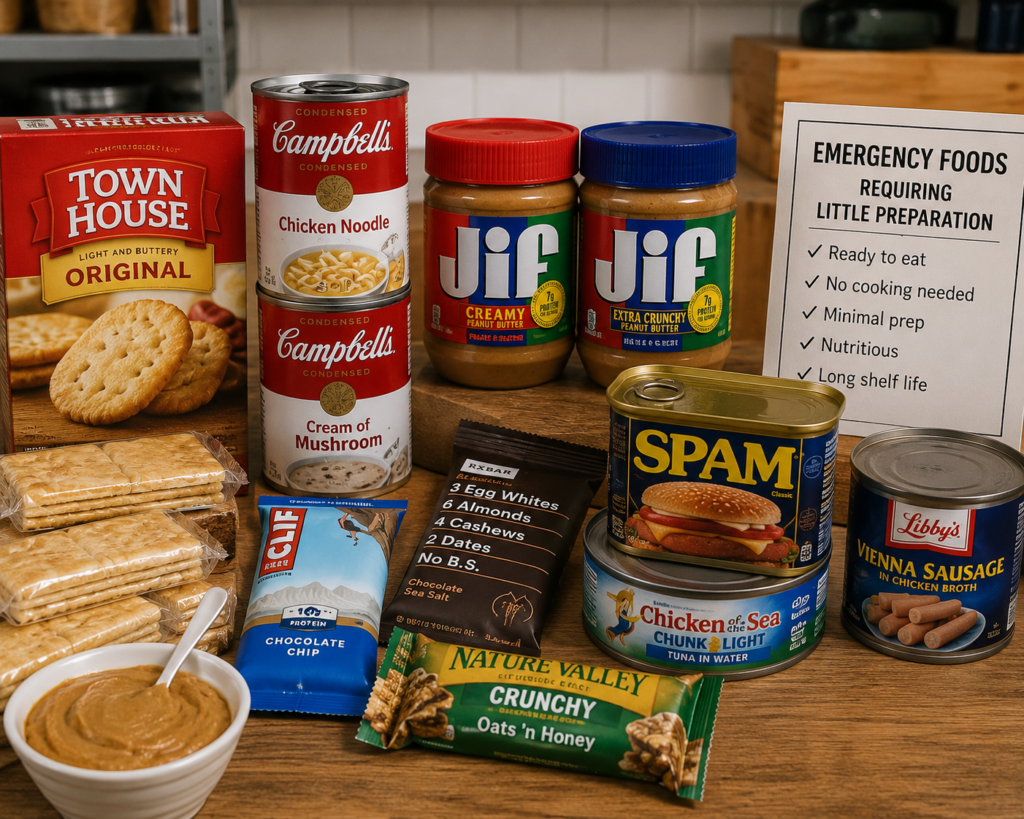
Peanut butter is so familiar that it’s easy to overlook.
But familiarity can be one of the most valuable qualities in an emergency pantry.
You already know whether your household likes it.
You probably know how quickly you use it.
You may already have several foods that pair naturally with it.
Bread, crackers, oatmeal, and other familiar foods can all provide different ways to use it.
That makes peanut butter an example of a broader strategy: build around foods that already have a place in your household’s routine.
You don’t have to create a completely separate emergency diet.
Instead, look at what you normally purchase and identify foods that make sense to keep in slightly larger quantities.
Individual dietary needs and allergies obviously matter, so peanut butter won’t be appropriate for everyone.
The underlying principle is what matters:
A food you’re already comfortable eating is usually easier to maintain than one you’ve never tried.
7. Canned Beans
Canned beans solve a different problem from dried beans:
Time.
Dried beans can be economical and versatile, but they require preparation.
Canned beans are already cooked, making them useful when you want something that requires less work.
Black beans can be used in tacos, rice dishes, or salads.
Kidney beans can go into chili.
Chickpeas can become part of salads or other simple dishes.
White beans can work well in soups.
That convenience can be especially valuable when you’re tired, busy, or dealing with a disruption to your normal routine.
Canned beans can also complement dried beans rather than replace them.
You might use dried beans when you have plenty of time and canned beans when convenience matters more.
That’s a practical distinction worth considering when deciding how much of each type to keep.
8. Crackers
Crackers probably aren’t the first food people think about when building an emergency pantry.
But they can provide something important:
a simple, ready-to-eat option.
Not every situation will call for a cooked meal.
There may be times when you want something quick or need an easy accompaniment to another food.
Crackers can be paired with peanut butter, canned foods, spreads, or other pantry items.
They also provide some welcome textural variety.
That may sound like a small consideration, but eating the same types of food repeatedly can make a pantry feel much less appealing.
A supply doesn’t have to be luxurious to be practical.
Sometimes simply having a few different textures and snack options makes the food you have feel more manageable.
The main consideration with crackers is that they can lose quality when exposed to moisture, particularly after opening.
So unlike some pantry staples, they benefit from being purchased in quantities your household can realistically use.
9. Canned Fruit
Emergency food doesn’t have to consist entirely of beans, rice, pasta, and canned vegetables.
Canned fruit can provide something different:
a change of flavor.
Peaches, pears, pineapple, applesauce, and other shelf-stable fruit products can work as snacks, side dishes, or additions to meals.
They can also help keep a pantry from becoming overwhelmingly savory.
This matters because emergency preparation is sometimes approached as a purely numerical exercise.
How many calories?
How many cans?
How many days?
Those questions are useful, but they’re not the whole picture.
People still have preferences.
They still get tired of repetitive meals.
And they still appreciate having something different from time to time.
If your household normally eats fruit, keeping some shelf-stable options available can be a simple way to preserve that variety.
There’s no need to save every can for an emergency, either.
Using your pantry foods as part of ordinary life makes it easier to keep track of what you have and replace items as needed.
10. Pasta Sauce
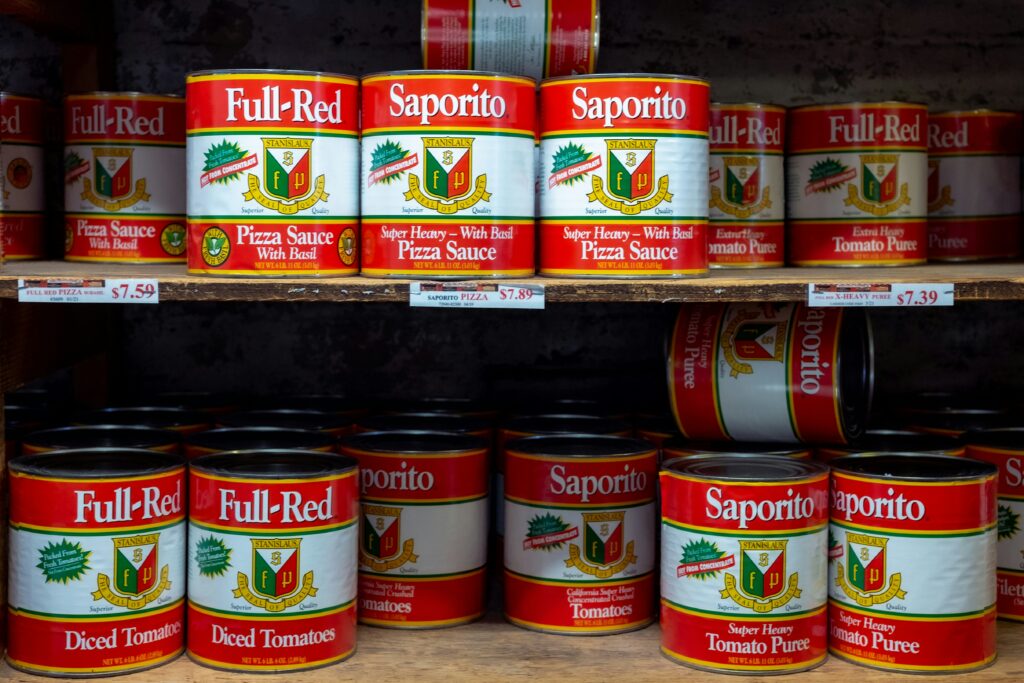
Pasta sauce may seem like something you buy for one specific dinner.
But it can be more useful than that.
Its biggest advantage is convenience.
If you’re already keeping pasta, rice, canned vegetables, beans, or other staples, a ready-made sauce can provide an easy way to add flavor without starting from scratch.
It can also save preparation time.
That’s particularly useful when you’re trying to make a simple meal without having to combine a long list of ingredients.
Think of pasta sauce as a shortcut rather than simply a pasta ingredient.
Sometimes a pantry doesn’t need another basic staple.
It needs something that makes the staples you already have easier to use.
That’s a valuable role for convenience foods.
The Bigger Lesson: Don’t over complicate Your Pantry
Looking at these 10 foods, you’ll notice that they aren’t all useful for the same reason.
Rice provides a familiar foundation.
Dried beans offer an economical option when you have time to cook.
Canned beans provide convenience.
Oats fit naturally into an existing breakfast routine.
Canned tomatoes and pasta sauce add flexibility and flavor.
Crackers and canned fruit provide easy variety.
Peanut butter is familiar and convenient.
That variety of roles is more useful than simply having ten different foods sitting on a shelf.
A practical pantry should make everyday life easier, not create another project you have to manage.
Start With What You Already Buy
One of the easiest ways to make pantry preparation unnecessarily complicated is to create a completely separate list of foods your household never normally purchases.
Instead, look at your grocery habits.
What do you buy every week?
What do you regularly run out of?
Which foods does everyone in the household actually eat?
Those answers can tell you more about what belongs in your pantry than a generic list ever could.
If your family eats pasta every week, keeping extra pasta makes sense.
If nobody eats dried beans, don’t feel obligated to fill your shelves with them simply because they’re inexpensive.
The goal isn’t to build somebody else’s ideal pantry.
It’s to build your household’s practical pantry.
Consider Preparation Time
Another useful question is:
How much work does this food require before I can eat it?
That distinction becomes important when you’re dealing with a disruption.
Some foods require cooking.
Some require very little preparation.
Some can be eaten immediately.
You don’t necessarily need to choose one category over another.
Instead, make sure you aren’t accidentally building a pantry that depends entirely on one type of preparation.
Don’t Try to Build Everything at Once
You also don’t need to purchase a month’s worth of food in one shopping trip.
That can make preparation feel expensive and overwhelming.
Start with a few foods you already use.
When your budget allows, buy an extra package.
Use the older supply during normal meals.
Replace what you use.
Then gradually add another category.
Over time, those small decisions can become a meaningful reserve without requiring a major one-time purchase.
A Simple Pantry Check
Take 10 minutes and look through your current pantry.
Choose five foods you already have and ask:
Do we actually eat this?
If not, reconsider buying more.
How much preparation does it require?
This can reveal gaps in your pantry.
Can I use it in several familiar ways?
Versatility can make a modest supply much more useful.
Would this food still make sense for our household if our normal shopping routine were interrupted?
If the answer is yes, you’ve probably found something worth keeping on hand.
You don’t have to fix every weakness immediately.
The goal is simply to understand what you already have.
Don’t Forget the Foods You Already Have
Emergency preparation doesn’t necessarily require a completely different pantry.
You may already have the beginnings of one.
There could be rice in a cabinet, pasta in a drawer, canned beans on a shelf, oats waiting for breakfast, and peanut butter ready for a sandwich.
The next step may not be buying more.
It may simply be recognizing what you already have and deciding where the gaps really are.
That’s a much less intimidating approach.
You can gradually improve your pantry without filling every available space or spending a large amount of money at once.
Recommended Resource: The Lost Super Foods
If you’re building a long-term emergency food supply, it’s worth learning about the foods our grandparents and earlier generations relied on before modern refrigeration and grocery stores became common.
The Lost Super Foods is a guide that explores forgotten preservation methods, shelf-stable foods, and traditional survival recipes that helped families thrive during difficult times. The guide includes practical information on food storage, preservation techniques, and nutrient-dense foods that can complement a well-stocked emergency pantry.
Whether you’re just starting your preparedness journey or looking to expand your food storage knowledge, this resource may provide valuable insights for creating a more resilient pantry.
👉 Click here to learn more about The Lost Super Foods.
Final Thoughts
A practical emergency pantry doesn’t have to be complicated, expensive, or filled with unfamiliar foods.
Some of the easiest foods to keep on hand are probably already part of your normal grocery routine.
White rice, dried and canned beans, pasta, oats, canned tomatoes, peanut butter, crackers, canned fruit, and pasta sauce can all serve useful roles—but for different reasons.
Some save time.
Some provide variety.
Some are inexpensive staples.
Some make familiar meals easier.
Some are simply foods your household already knows and enjoys.
That’s the approach I’d take when building a pantry: start with the foods that already make sense for your household, then fill the gaps gradually.
You don’t need a perfect pantry.
You need one that is practical enough to maintain, flexible enough to use, and familiar enough that the food won’t sit forgotten on a shelf.
Start small.
Use what you buy.
Pay attention to what your household actually reaches for.
Then build from there.
Want to build a stronger emergency pantry? These guides will help:
Related Articles
25 Emergency Foods You Have Already Have In Your Kitchen